30P30N
Multi-element high-lift airfoil.

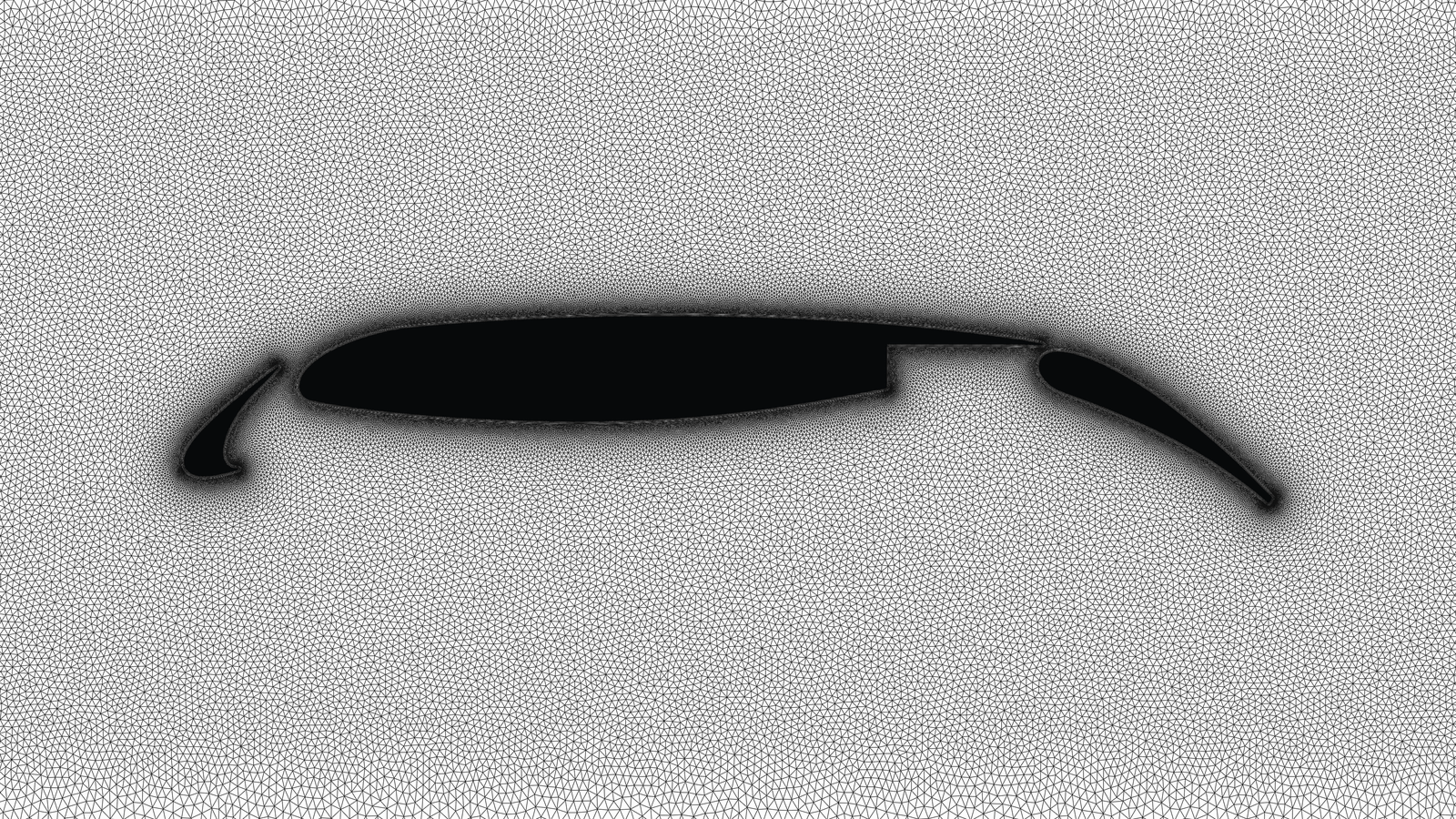
A demanding three-element high-lift benchmark meshed with RobustMesh and exported directly to OpenFOAM for a k–ω SST RANS simulation.

NARROW GAPS · WALL-RESOLVED · SEPARATION & RECIRCULATION · STEADY INCOMPRESSIBLE AERODYNAMICS
Mesh
310,484 cells
Prismatic layer
30 layers
First prismatic cell height
5 × 10⁻⁶ m
Expansion ratio
1.18
Near-wall target
y+ ~ 1
Core mesh type
Triangle

01 / 30P30N geometry

This study considers the 30P30N airfoil in its extended high-lift configuration at an angle of attack of 0°. All dimensions are normalised by a reference chord cref = 1 m, defined for the airfoil in its retracted configuration.
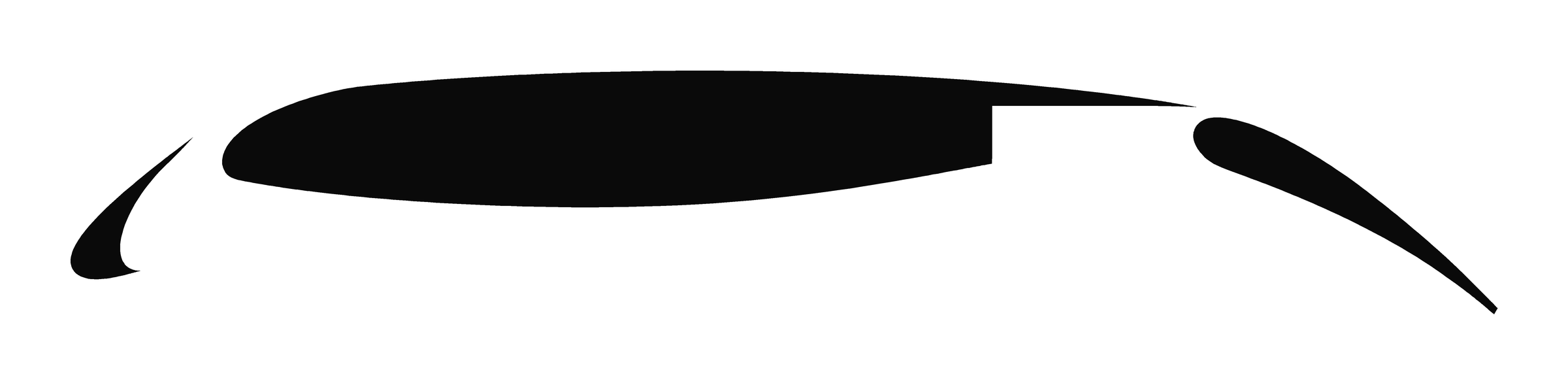
Extended 30P30N geometry with slat, main element and flap
ConfigurationExtended
Angle of attack0°
Reference chord1 m · retracted configuration

02 / Mesh composition and spatial resolution

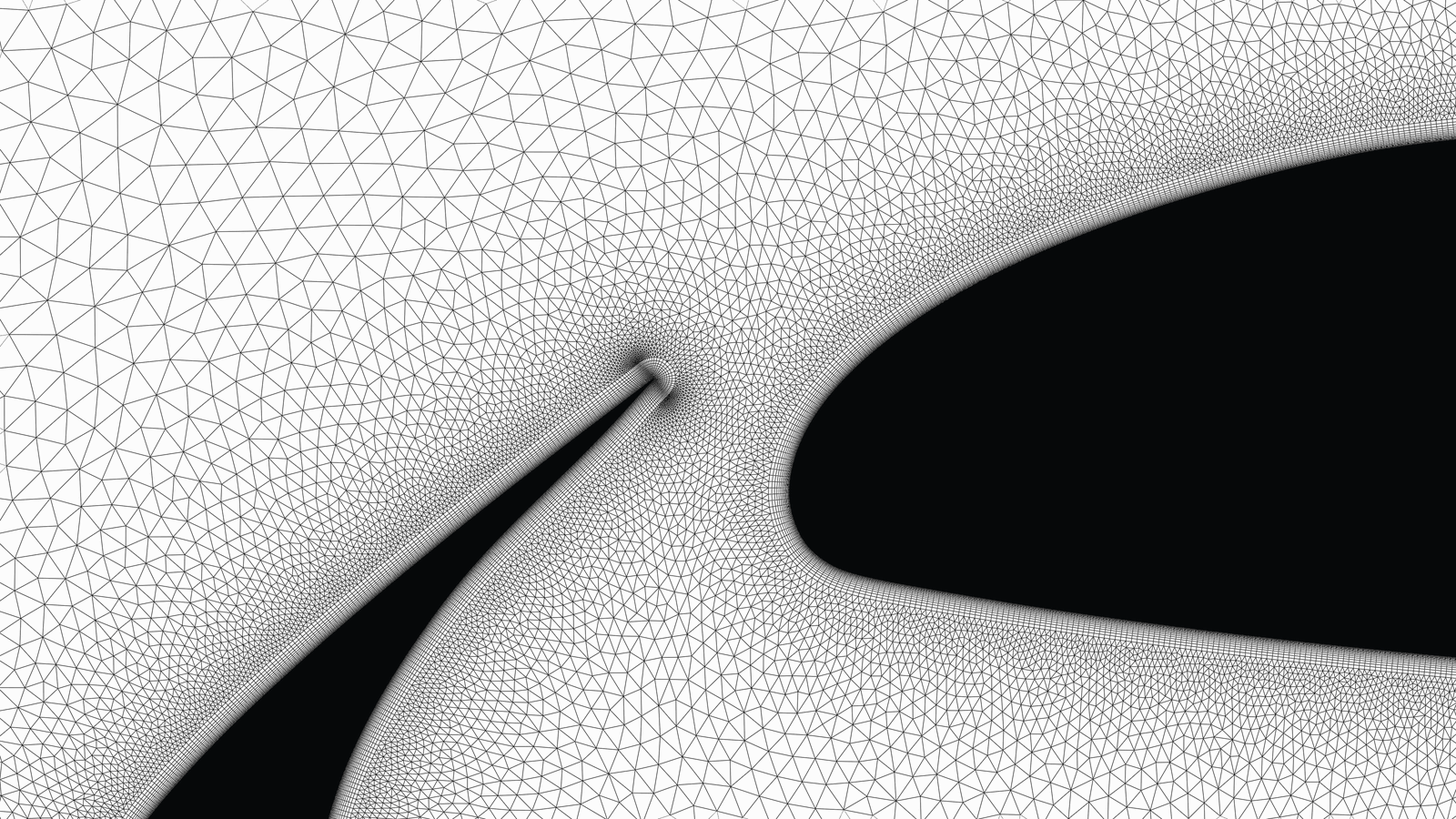
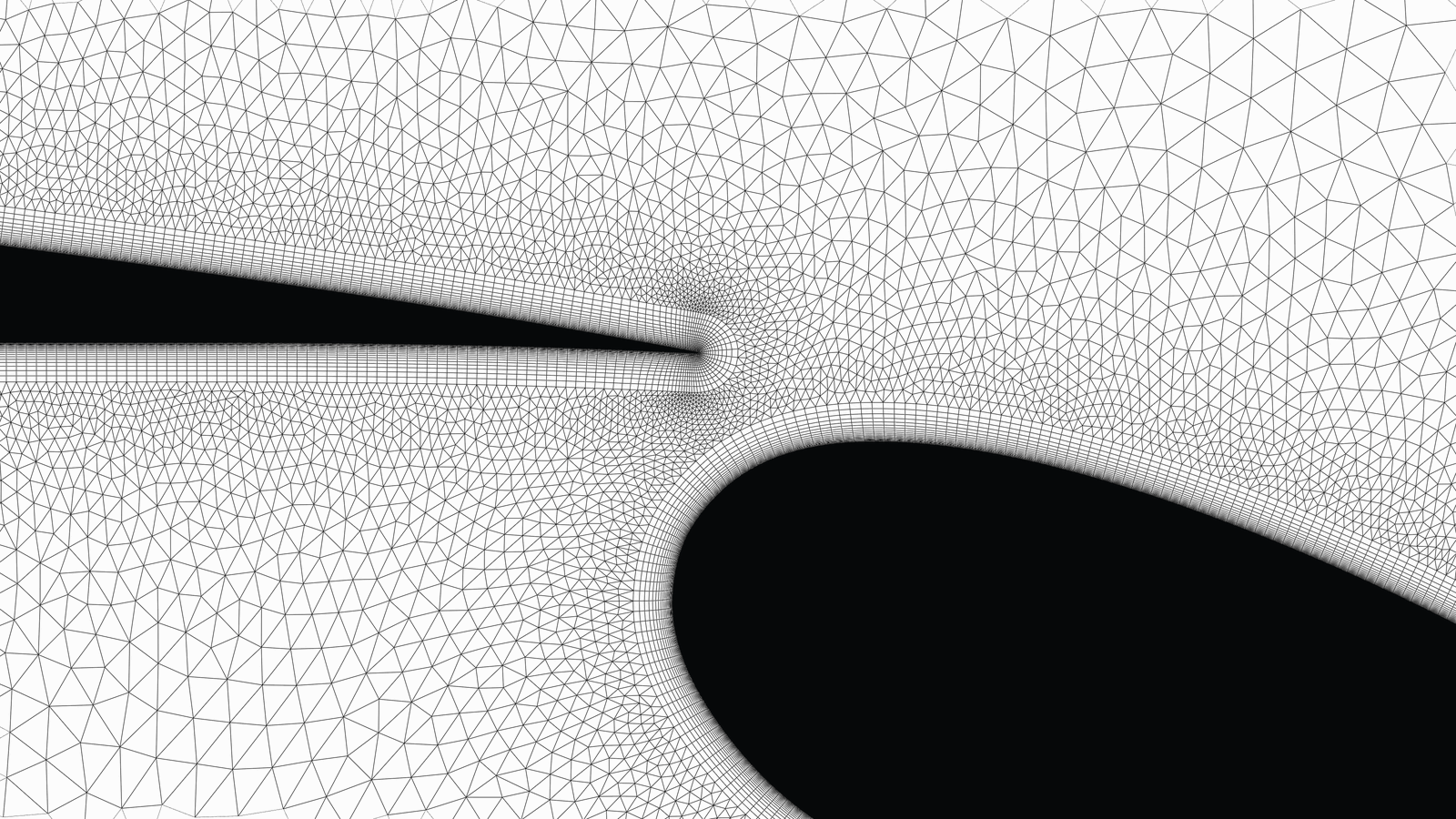
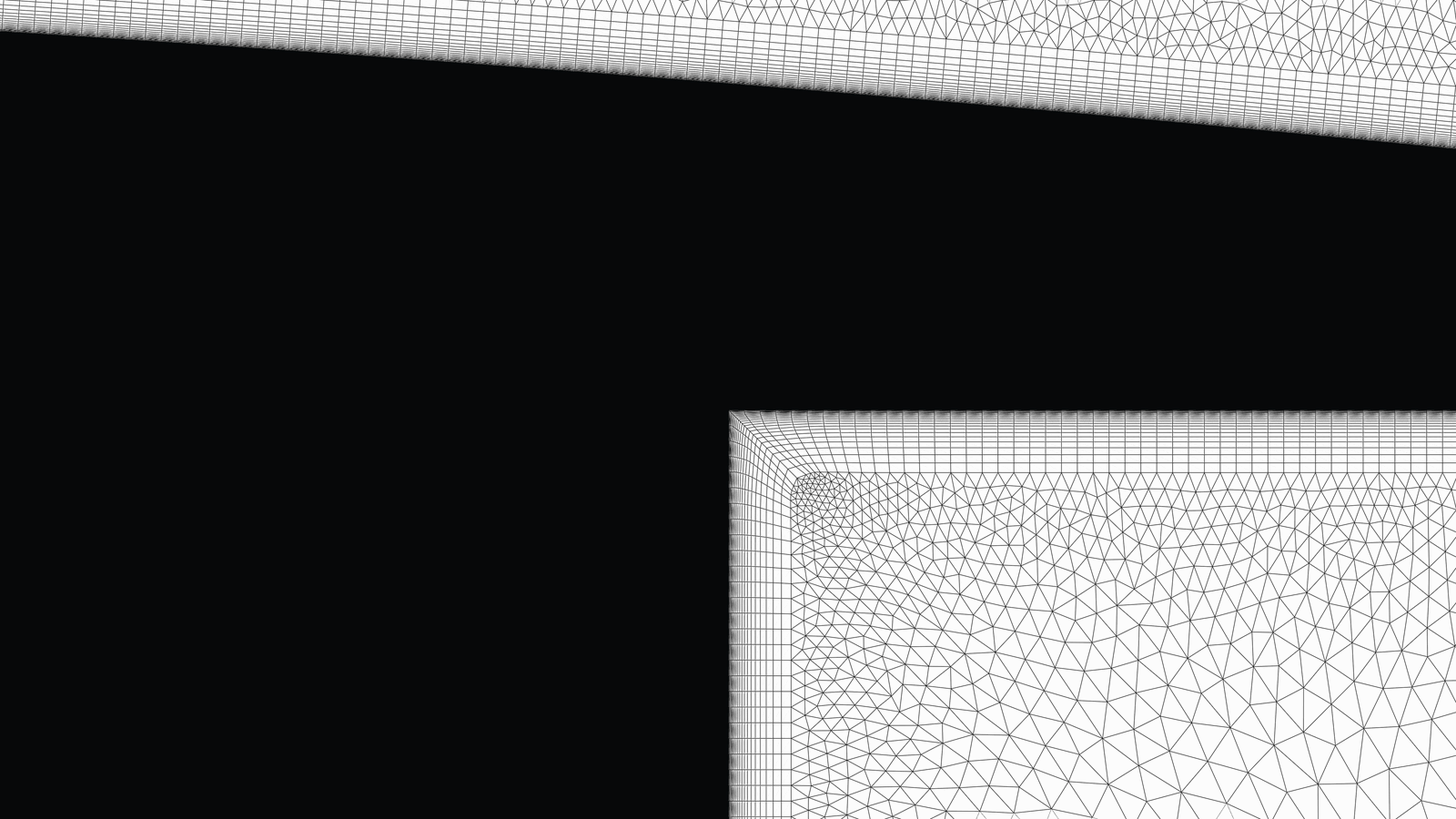
The final mesh combines three nested refinement zones with 30 prismatic layers along the slat, main element and flap. The first prismatic cell is 5 × 10⁻⁶ m thick and the layers use an expansion ratio of 1.18, targeting y+ ~ 1. The rest of the domain is discretised with a graded triangular core.

Prismatic layers 213,134

Prismatic cells · 30 layers over the three-element geometry

Core region 97,350

Triangular cells · graded from the near field to the prismatic cells

Exported mesh 310,484

Total cells

Spatial sizing · robustMeshDict

Three nested refinement zones

Full CFD domain with the three 30P30N refinement zones drawn at their exact relative scale
multi_element_fine
X extent
−0.5 → 1.5
Y extent
−0.45 → 0.40
Size (L × H)
2.0 m × 0.85 m
Max mesh size
0.010 m
airfoil_halo
X extent
−1.5 → 3.0
Y extent
−1.2 → 1.0
Size (L × H)
4.5 m × 2.2 m
Max mesh size
0.030 m
outer_field
X extent
−15 → 30
Y extent
−15 → 15
Size (L × H)
45 m × 30 m
Max mesh size
0.700 m
Mesh images

03 / Mesh quality

The cell-quality values and distributions below are taken from the OpenFOAM checkMesh report for the final mesh.

Angular quality

Non-orthogonality

Min0.0000°
Mean5.6203°
Max59.4491°
Cell distortion

Skewness

Min0.0000
Mean0.0513
Max2.4998
Cell stretching

Aspect ratio

Min1.0000
Mean3.3707
Max199.1033
Interpolation quality

Face weight

Min0.0185
Mean0.5078
Max0.8564

04 / Simulation results

The completed steady k–ω SST RANS calculation at Re = 5 × 10⁶, run with simpleFoam from OpenFOAM v2406 over 2,000 iterations, confirms the near-wall resolution across all three elements.

Simulation diagnostics

Convergence and near-wall diagnostics

Convergence

Solver residuals over 2,000 iterations

Uₓ final · 3.57e-6
Uᵧ final · 5.35e-5
p final · 5.90e-6
ω final · 8.75e-9
k final · 7.92e-7
Wall resolution

y+ distribution at iteration 2,000

Min0.0043
Mean0.4156
Max1.4134
Main element
Min0.004311
Mean0.426
Max1.413
Flap
Min0.01468
Mean0.356
Max1.066
Slat
Min0.02082
Mean0.476
Max0.797
Law of the wall

U+ vs y+ at iteration 2,000

uτ0.0532
Sample pointx = 0.751
Simulated profile
U⁺ = y⁺viscous sublayer
U⁺ = ln(y⁺)/κ + Bcanonical log-law reference
Flow solution

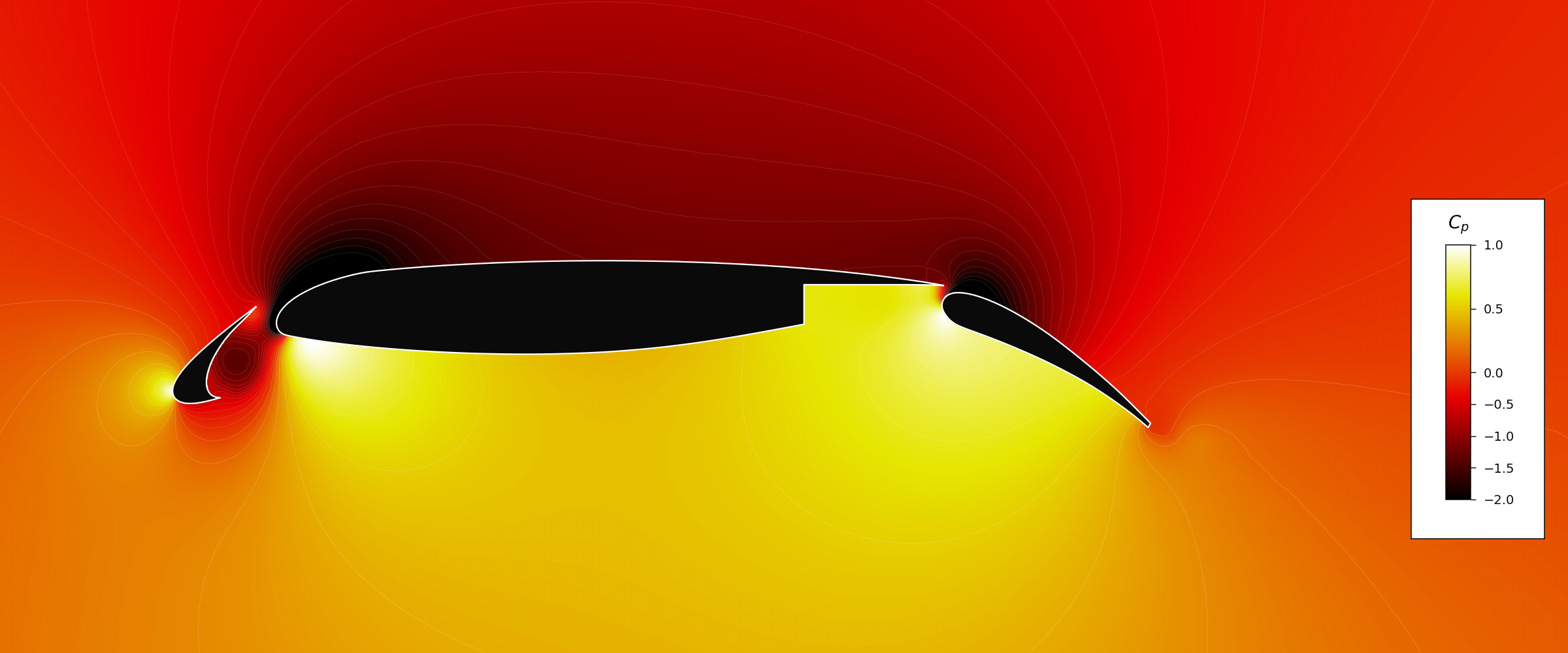
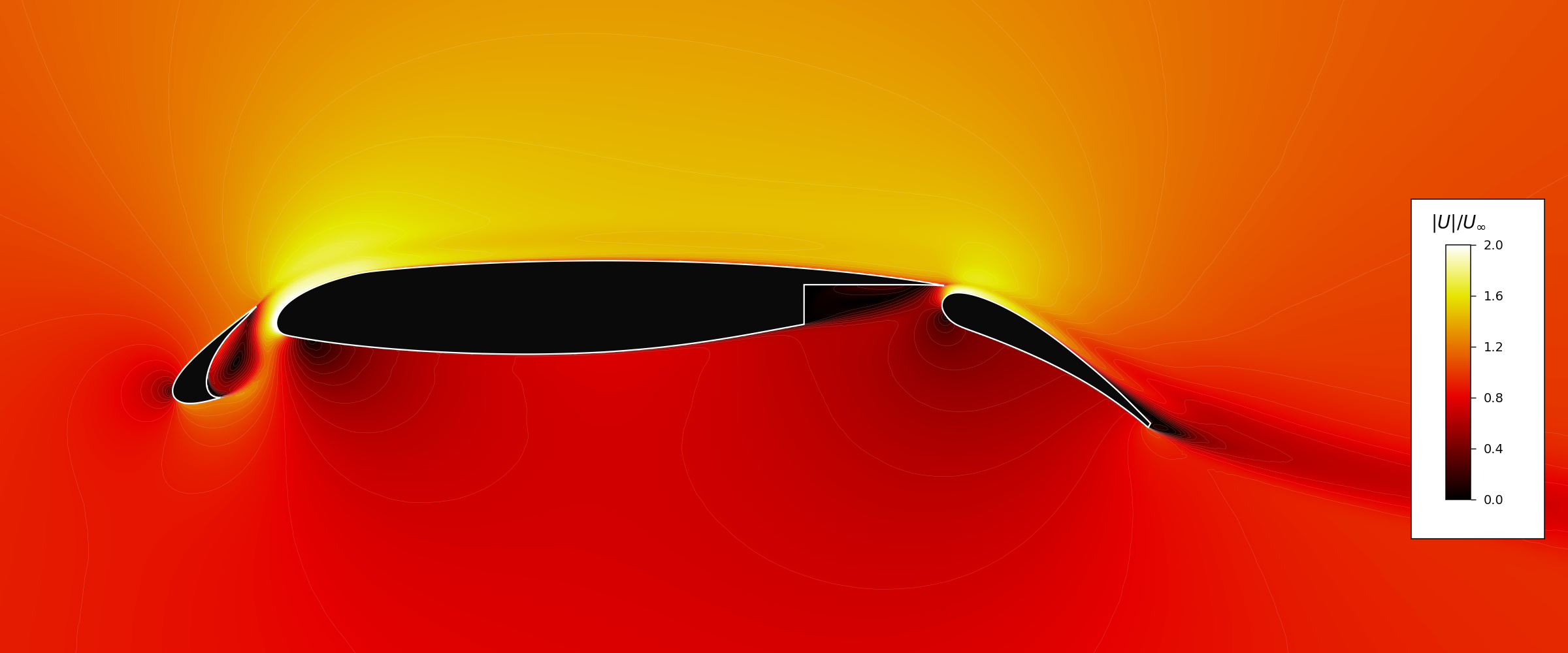
Pressure and velocity fields

Pressure-coefficient field around the 30P30N airfoil averaged over iterations 1,001 to 2,000
Pressure coefficient Cp field · mean over iterations 1,001–2,000
Velocity-magnitude field around the 30P30N airfoil averaged over iterations 1,001 to 2,000
Velocity magnitude |U| field · mean over iterations 1,001–2,000
Experimental validation

Aerodynamic coefficients

CoefficientExperimentRobustMesh + OpenFOAM 2406Percent Error (%)
ClLift coefficient2.167¹2.195²+1.3%
CdDrag coefficient0.0332¹0.0347²+4.5%

¹ Experimental reference data are taken from S. M. Klausmeyer and J. C. Lin, "Comparative Results From a CFD Challenge Over a 2D Three-Element High-Lift Airfoil," NASA Technical Memorandum 112858, NASA Langley Research Center, 1997; "Prediction of High Lift: Review of Present CFD Capability," Progress in Aerospace Sciences, Vol. 38, pp. 145–180, 2002; and "Numerical Study to Assess Sulfur Hexafluoride as a Medium for Testing Multi-Element Airfoils," NASA Technical Paper 3496.

The numerical experimental values shown here were digitized by Wolf Dynamics from published data as part of their validation case. Exact numerical accuracy is therefore not guaranteed.

² The CFD coefficients converged from iteration 1,001 onward but remained in an oscillatory regime; Cl and Cd were therefore averaged over iterations 1,001–2,000 (N=1,000).

05 / Files

All RobustMesh configuration files, the complete OpenFOAM v2406 case, the generated mesh, and the simulation results can be downloaded here.